0%

Choosing a Liquid Juice and Oil Filling Machine is not just about speed. It is about keeping every bottle clean, accurately filled, and ready for the next station. Juice can foam; oil can cling to nozzles. A line that handles both needs the right filling principle, changeover design, and container controls.

The scale of the market makes careful selection worthwhile. PMMI’s 2024 State of the Industry report estimated U.S. packaging machinery shipments at $10.9 billion in 2023, up 4.8% from 2022. That figure covers packaging machinery broadly, not liquid fillers alone. It still signals investment in production equipment. PMMI executive Jorge Izquierdo has discussed automation and operational efficiency as important industry priorities. In paraphrase, not as a verbatim quotation: “Choose automation that solves a real production constraint.” That distinction matters. A faster filler may still disappoint if changeovers are slow or foaming causes inconsistent fills.

This guide compares ten machines for juice, edible oil, and similar products. It considers filling accuracy, bottle compatibility, cleaning access, output, and support. Look closely at the details: a narrow nozzle, a dripping valve, or a difficult-to-reach hose can affect a full shift. Small things matter. Specifications also need verification with the supplier and the actual product. Viscosity, temperature, and bottle shape can change performance. No model is best for every plant. The comparisons that follow offer a starting point—not a substitute for a product trial and a line-specific assessment.
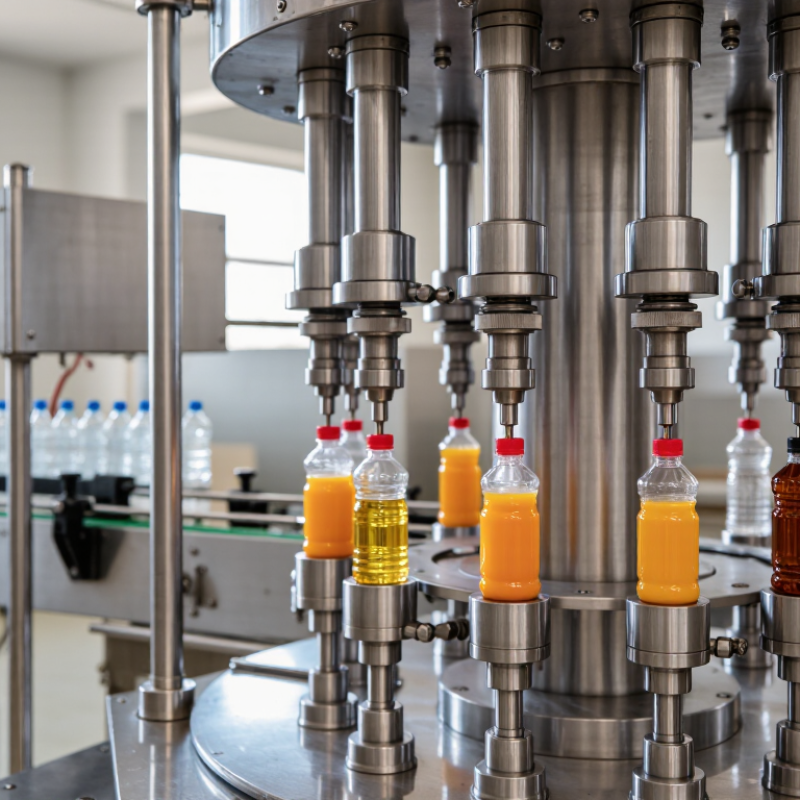
10 Best Liquid Juice and Oil Filling Machines in 2026?

How Juice and Oil Filling Machines Work

How Juice and Oil Filling Machines Work

A filling machine moves liquid from a holding tank into clean, positioned containers. A pump or gravity feed supplies each nozzle, while a valve controls the dose. Volumetric systems measure by volume; mass-based systems use weight or flow sensors. The nozzle closes when the target is reached. Then containers move to capping and inspection stations. Simple in theory.

Product behavior changes the setup. Juice may foam, carry pulp, or splash, so nozzle height and filling speed matter. Oil flows differently as its temperature shifts; operators should calibrate the filler under actual production conditions. A few degrees can change the result. Small details matter. In practice, teams also check fill levels, drips, and container stability during startup—not only after a fault appears.

PMMI’s 2024 State of the Industry report puts U.S. packaging machinery shipments at about $10.9 billion in 2023, reflecting the scale of investment in automated packaging. That figure covers packaging machinery broadly, not fillers alone. FAO’s 2019 food-loss report estimated that 14% of food is lost between post-harvest and retail; it does not attribute that loss to filling lines. Still, controlled dosing and clean transfers can help limit avoidable spills. A less obvious weakness is setup time: frequent product changes can make a fast machine less useful than its headline speed suggests.

Main Types of Liquid Filling Machines

Main Types of Liquid Filling Machines

Liquid filling machines are commonly grouped by how they move and measure product. Gravity fillers use the liquid’s own weight, making them suitable for thin, free-flowing juices. Overflow fillers help keep fill levels visually consistent across clear bottles. They are less suited to thick oils. Simple, but not universal.

Pump fillers move liquids through a controlled flow path. They can accommodate different viscosities, depending on pump design and setup. Piston fillers measure a set volume and often suit thicker oils or juice concentrates. Peristaltic fillers move product through flexible tubing, which can simplify cleaning between runs. However, tubing wears and needs regular inspection.

Tips: Match the filler to the liquid, container, and target speed. For juice with pulp, check that valves and nozzles have wide enough passages. Test actual product samples before choosing equipment. A machine may perform differently when the liquid is cold, foamy, or more viscous than expected. Check fill accuracy over repeated cycles, not just one bottle.

How to Evaluate Filling Machines in 2026

How to Evaluate Filling Machines in 2026

Test a filling machine with your actual liquid, bottle, cap, and target speed—not a vendor’s ideal sample. Record fill-weight variation at startup, during steady running, and after a restart. Measure drips, foam, and rejected containers, too. Thin juice and viscous oil respond differently to temperature changes. Small test. Big difference.

PMMI’s 2024 State of the Industry report puts U.S. packaging machinery shipments at about $10.9 billion in 2023. That scale makes careful comparison worthwhile. Check sustained output on your line, then time changeovers and cleaning. Ask for written acceptance criteria and service-response estimates, not just a polished demonstration.

Automation deserves scrutiny, not hype. The International Federation of Robotics’ World Robotics 2024 report counted 4.28 million industrial robots operating worldwide in 2023, up 10% from 2022. For a filler, check control-system compatibility, fault records, recipe access, and what happens when a sensor fails. CIP claims also need product-specific proof; some contact parts may still require manual inspection. It is tempting to focus on the highest advertised bottles-per-minute figure, but that number may not reflect your real production conditions.

10 Best Liquid Juice and Oil Filling Machines in 2026? - How to Evaluate Filling Machines in 2026

The options below compare common filling technologies and machine configurations—not specific brands or models. “Best” depends on the liquid, container, hygiene requirements, and production scale.

Option Filling technology or configuration Best suited to Liquid and viscosity fit Container fit Key advantages Evaluation points
1 Gravity filler Simple, small-scale filling of still liquids Thin, free-flowing liquids such as filtered juice and some edible oils Bottles and other containers with openings suited to the filling nozzle Simple operating principle and relatively straightforward cleaning Filling speed and consistency depend on liquid flow, fill level, and container design. Not ideal for thick or pulpy products.
2 Overflow level filler Products where a consistent visible fill line matters Low-viscosity, non-carbonated liquids; usually unsuitable for products with substantial pulp or foam Compatible bottles with consistent neck and opening dimensions Creates a uniform-looking fill level, which can help when bottle capacity varies slightly Product may be recirculated; check foaming behavior, changeover needs, and compatibility with the liquid.
3 Piston volumetric filler Measured doses and products that need positive displacement Medium to thicker liquids, including many oils, sauces, and some pulpy products, subject to pump and valve design Bottles, jars, and other containers that can be positioned under the nozzle Delivers a measured volume and can handle a wider viscosity range than simple gravity filling Confirm that the piston, seals, valves, and product path suit the liquid and any suspended particles. Cleaning may take longer.
4 Peristaltic pump filler Small batches, frequent product changes, or applications needing a contained product path Low- to medium-viscosity liquids; product suitability depends on tubing material and particle size Small bottles, vials, and containers that can be accurately indexed or positioned Liquid contacts the tubing rather than pump internals; tubing can be replaced for product changeovers Assess tubing compatibility, wear, replacement cost, and whether the required production rate is achievable.
5 Gear pump filler Metered filling of oils and other pumpable liquids Often suited to lubricating or edible oils and other liquids whose viscosity is within the pump’s operating range Bottles, cans, and other formats supported by the dosing and nozzle arrangement Can provide controlled, repeatable dosing and is commonly applied to oil products Check material compatibility, cleanability, seal design, and performance across the product’s temperature range.
6 Time-pressure filler Basic or budget-conscious dosing setups Primarily free-flowing liquids; consistency can be affected by changing viscosity or supply pressure Containers compatible with the selected nozzle and filling setup Relatively simple dosing control and a straightforward setup for suitable products Because dose depends on flow over time, verify repeatability when product temperature, pressure, or viscosity changes.
7 Mass-flow-meter filler Applications where measuring product mass is important Can be used for many liquid products; meter selection and installation must match the liquid and process conditions Containers supported by the filling station and control system Measures mass flow rather than relying only on timed flow or container volume Review meter range, accuracy documentation, calibration, product compatibility, and system cost. A suitable meter is essential.
8 Magnetic flow-meter filler Metered filling of electrically conductive liquids May suit conductive aqueous products such as many juices; generally not suitable for non-conductive edible oils Containers supported by the filling station and nozzle arrangement Has no moving parts in the flow tube and can be suitable for hygienic liquid-processing lines Confirm the liquid’s electrical conductivity and the meter’s liner, electrode, and cleaning compatibility before selection.
9 Vacuum filler Some thin liquids filled into compatible rigid containers Low-viscosity liquids; product behavior and foaming must be checked Most appropriate for containers and closures designed to work with the vacuum filling process Can help achieve controlled filling in suitable container-and-product combinations Check container strength, vacuum compatibility, foam control, and whether the process is appropriate for the product.
10 Automatic multi-head or rotary filling line Higher-volume production with repeated container formats Can be configured for different juice or oil products using suitable filling valves or metering systems Best for standardized containers and established production runs Multiple filling stations can increase line throughput and reduce manual handling Evaluate changeover time, cleaning access, line integration, container handling, staffing, and the cost of unused capacity.

Figures and performance are not specified because actual output and filling accuracy vary by machine design, number of filling heads, dose size, liquid temperature and viscosity, container geometry, and operating conditions. Before purchasing, request product-specific trials and verify food-contact materials, cleaning procedures, calibration requirements, and applicable local regulations.

Ten Leading Juice and Oil Filling Machines Compared

Comparing ten leading juice and oil filling machines starts with the product, not the advertised speed. Gravity fillers suit thin, free-flowing juices, while piston fillers handle thicker blends when their valves can pass pulp. Peristaltic systems offer gentle, measured filling for smaller batches, though tubing wears and needs regular inspection. Gear-pump fillers can meter viscous oils, but seals and cleaning access matter.

Flow-meter fillers measure liquid electronically and can support repeatable dosing across changing volumes. Overflow fillers prioritize a consistent level in clear containers; foam can complicate results. Vacuum fillers are suited to certain glass-bottle applications, but require compatible containers and careful setup. Net-weight fillers measure each container by mass, which can help when product density varies. Check actual accuracy with your own liquid. It can surprise you.

For higher output, rotary machines fill multiple containers as they move through a rotating station. Inline fillers use a straight conveyor layout and may be easier to adapt to different production runs. Hot-fill equipment is designed for products filled at elevated temperatures, but not every juice needs this process. Compare changeover time, cleanability, container range, and real-world fill tests. A machine that looks efficient on paper may be awkward to wash between sticky batches. That detail is easy to overlook.

10 Best Liquid Juice and Oil Filling Machines in 2026? — Filling Machine Types Compared

Indicative operating-speed ranges for common filling machine types, in bottles per minute. Actual throughput varies with product viscosity, container size, fill volume, and automation level.

These broad ranges are general industry estimates, not guaranteed specifications for individual machines. Juice with pulp and viscous oils may require different equipment or run at lower speeds.

Operating, Cleaning, and Maintaining Filling Equipment

For liquid juice and oil filling machines, operating discipline starts before the first bottle arrives. Check product temperature, fill volume, nozzle alignment, and seal condition during a short test run. Watch for foaming in juice and slow dripping from oil nozzles; both can signal setup problems. Small details matter. Keep a written record of settings and any adjustments, so the next shift is not guessing. Siemens’ 2024 True Cost of Downtime report estimates that unplanned downtime costs manufacturers about $1.4 trillion globally each year. That figure is not specific to filling lines, but it shows why routine checks can protect production time.

Cleaning needs equal care. Drain the product circuit, follow the machine maker’s approved wash sequence, and inspect valves, gaskets, and nozzle interiors for residue. Oil can leave a thin film that a quick rinse may miss. Juice sugars can dry into sticky deposits. Use suitable cleaning tools, then verify the surfaces are clean and fully rinsed before production resumes. Do not guess. Record cleaning time, chemical concentration, and inspection results. Maintenance should include checking seals for swelling or cracks, tightening loose fittings, and confirming sensors respond consistently. A checklist helps, though it cannot replace a trained operator’s eyes; small leaks and unusual sounds are easy to overlook during a busy changeover.

FAQS

How does a liquid filling machine work?

A pump or gravity feed moves liquid from a tank to a nozzle. A valve stops the flow when the measured dose is reached. Containers then move to capping and inspection.

Which filler works well for thin juice?

Gravity fillers can suit thin, free-flowing juice. Overflow fillers help create similar-looking levels in clear bottles. Foam may affect results.

Can a machine fill juice containing pulp?

Yes, if its valves and nozzles have passages wide enough for the pulp. Test real samples across repeated cycles. One bottle is not enough.

What should operators consider when filling oil?

Oil flow can change with temperature. Calibrate the filler under actual production conditions, and check fill levels and drips during startup.

When might a piston filler be useful?

Piston fillers measure a set volume and can suit thicker oils or juice concentrates. Their valves must handle the product’s thickness and any pulp.

How do peristaltic fillers need to be maintained?

Product moves through flexible tubing, which can simplify cleaning between runs. Tubing wears over time, so inspect it regularly.

What should teams compare before choosing a filler?

Compare accuracy, cleaning access, container range, and changeover time. A fast machine may become inconvenient between sticky batches. That part is easy to miss.

Does every juice need hot filling?

No. Hot-fill equipment handles products filled at elevated temperatures, but the process is not needed for every juice. Check the product and production requirements.

Conclusion

This guide explains how a Liquid Juice and Oil Filling Machine moves products from a supply tank into containers with controlled volume and minimal spillage. It introduces common filling approaches, including gravity, piston, pump, and flow-meter systems, and describes how product thickness, foaming, container shape, production speed, and required accuracy can influence the choice. A practical comparison framework helps readers assess capacity, adjustability, construction, ease of use, and suitability for different production needs.

The guide also compares ten leading types of juice and oil filling equipment in 2026, highlighting the features and trade-offs that may matter most to operators. Finally, it covers essential operating, cleaning, and maintenance practices, such as following equipment instructions, keeping product-contact parts clean, inspecting seals and connections, and checking fill consistency. Together, these topics offer a straightforward starting point for selecting and caring for filling equipment.

Vivienne

Vivienne

Vivienne is a professional marketing specialist dedicated to helping businesses understand products, markets, and customer needs through clear, reliable, and practical communication. With strong expertise in the company’s product portfolio, she regularly researches industry trends, evaluates......