A Sugar Sachet Packaging Machine can look simple on a specification sheet. In production, small details matter: powder dust around the hopper, uneven seals, and sachets that drift off-weight during a long shift. Choosing equipment for 2026 means matching the machine to the product, output target, and operators—not just comparing advertised speeds.
The broader market offers useful context, but not a direct forecast for sugar sachet lines. MarketsandMarkets’ Packaging Machinery Market report projected growth from USD 45.8 billion in 2023 to USD 59.2 billion by 2028, a 5.3% compound annual growth rate. This estimate covers packaging machinery across sectors, not sugar sachet machines alone. PMMI’s 2024 State of the Industry report is another useful reference for reviewing packaging equipment trends and investment conditions. These sources help frame the decision; they cannot replace a product trial.
A reliable comparison should examine dosing accuracy, sealing performance, film compatibility, changeover time, cleaning access, and service support. Ask suppliers to test your actual sugar and packaging film. Request sample sachets, weight records, and a clear explanation of the test conditions. Small sachets leave little room for error. A fast machine may still be the wrong choice if it creates waste or demands constant adjustment. And specifications can be incomplete. That deserves a second look. The following guide explains how to assess these trade-offs and select a machine suited to real operating conditions.
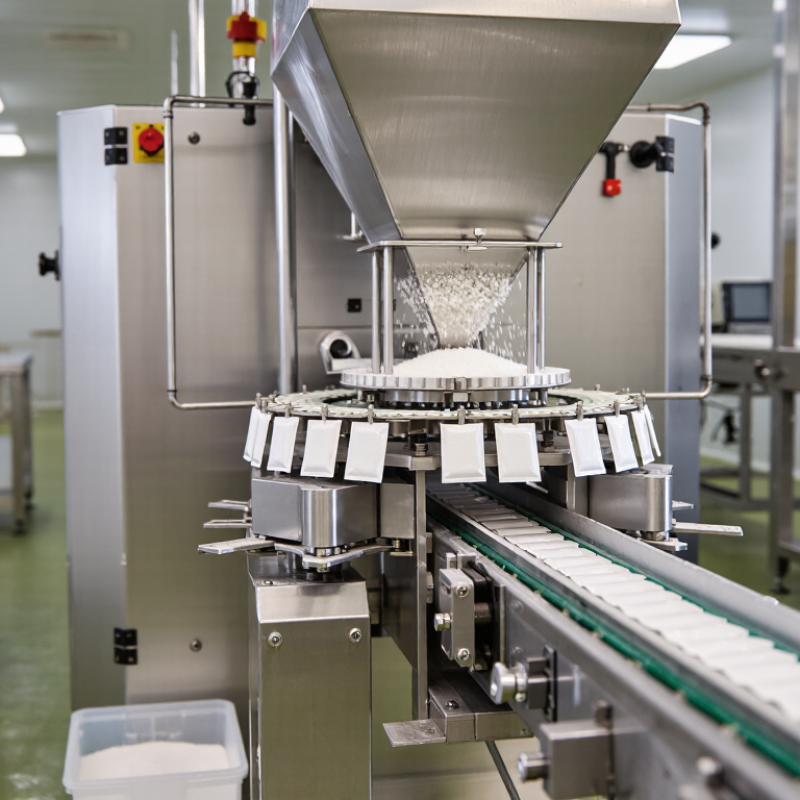
For a 1–10 g sugar sachet, define the target weight before choosing the bag dimensions. USDA FoodData Central lists one teaspoon of granulated sugar at about 4.2 g.
That gives a rough volume guide: 1 g is about 0.24 teaspoon, while 10 g is about 2.4 teaspoons. These are estimates, not machine settings. Crystal size, humidity, and settling can change the volume. Small sachets leave little room for error.
Ask for dosing data at both ends of your range, not just at 10 g. A machine that performs well on a larger dose may struggle to deliver a steady 1 g fill. Run repeated tests using your actual sugar, film, and sachet width. Check the filled weight, seal area, and whether sugar grains catch in the seals.
It is easy to overlook start-up variation. Request documented results, including average fill weight and variation across a production run. A convenient pack size can still be awkward to open, so test it with real users before fixing the dimensions. USDA FoodData Central is useful for a starting conversion; it cannot replace production trials.
A sugar sachet machine advertised at 120 sachets per minute may not deliver that rate on your product. Treat the 30–120 sachets-per-minute range as a comparison point, not a promise. Ask each supplier to run your target fill weight, sachet dimensions, and packaging film during a timed trial. Count accepted sachets, not just film cuts. A neat demo can hide stoppages.
At 30–60 sachets per minute, a compact line may suit modest daily demand or frequent product changes. Higher speeds can reduce labor per pack, but sugar dust, hopper bridging, and seal contamination may cause pauses. Watch the machine for at least 20 minutes. Record filled, sealed packs and rejected packs separately. Small details matter.
Request actual output logs, changeover time, and the conditions behind the quoted figure. Compare the same sugar granulation, pack weight, and film on every machine. Check whether one operator can refill the hopper and clear routine faults safely. I would also ask for a longer production trial; a short test is imperfect, but still more useful than a brochure. Leave room for maintenance and peak orders when choosing capacity.
When choosing a sugar sachet machine, test dose repeatability with your actual granule size, target weight, and production speed. Run consecutive fills and record each sachet’s weight, not just the average. Sugar dust can cling to dosing parts, while humidity may affect flow. Small changes matter. A clean factory trial can still mislead if it does not reflect your site conditions.
Check seals using practical leak and peel-strength tests, including after the film has been exposed to normal production heat. The European Commission’s 2023 RASFF Annual Report recorded 4,683 notifications across food and feed; this is a surveillance figure, not a machine-performance benchmark, but it highlights why traceability and documented checks matter. For food-contact materials, Regulation (EC) No 1935/2004 requires that materials do not transfer substances in amounts that endanger health or unacceptably alter food. If the sachet uses plastic materials within scope, EU Regulation No 10/2011 sets an overall migration limit of 10 mg/dm². Ask for declarations of compliance and relevant migration-test evidence for the complete packaging structure, including inks and adhesives where applicable. Get the documents. Verify the seal.
| Selection criterion | What to assess | Practical buying benchmark | How to verify |
|---|---|---|---|
| Dosing repeatability | Check the dosing method, sugar particle size, bulk-density variation, and performance at the intended sachet weight. Fine and coarse sugar may behave differently in the same feeder. | Set a written acceptance limit for the specific product and fill weight. A coefficient of variation (CV) of 1% or less can be used as an initial sourcing target, not as a universal legal limit. | Run a statistically meaningful trial using the buyer’s sugar. Weigh consecutive sachets on a calibrated scale and review average fill, standard deviation, CV, and out-of-tolerance units. |
| Filling range and accuracy | Confirm the machine’s usable dose range and whether dose adjustment requires a format change, feeder adjustment, or recipe setting. | Require trial results at the smallest and largest planned fill weights. Confirm the quoted range with the actual sugar rather than relying only on a catalogue specification. | Request documented test runs at each planned weight and check that the measured results meet the agreed product specification and applicable net-quantity rules. |
| Seal quality | Assess longitudinal and end seals, seal consistency, wrinkle formation, contamination by sugar dust, and compatibility with the proposed laminate. | Specify acceptable seal appearance and functional performance. There is no single seal-strength value that applies to every sachet film and pack design. | Test samples using an agreed seal-strength method, such as ASTM F88/F88M where appropriate, and perform leak or integrity testing suitable for the package design. |
| Film and sachet format | Check film width, thickness range, roll diameter, core size, print registration, sachet dimensions, and the machine’s supported sachet style. | Confirm compatibility with the exact packaging material specification and artwork. Include tolerances for film thickness, roll changes, and printed registration marks. | Run production film through the machine and inspect registration, cut position, seal location, and finished sachet dimensions over a sustained trial. |
| EU food-contact requirements | Regulation (EC) No 1935/2004 applies to materials and articles intended to come into contact with food; it is not, by itself, a machine-performance certification. | Identify every food-contact part and packaging material. Obtain applicable declarations and supporting documentation; plastics may also be subject to Regulation (EU) No 10/2011. | Review material specifications, declarations of compliance where applicable, traceability information, and evidence of good manufacturing practice under Regulation (EC) No 2023/2006. |
| Food-contact construction | Inspect product-contact surfaces, seals, joints, and any lubricants or cleaning agents that could present a contamination risk. | Request a food-contact parts list, material grades, surface-finish details where relevant, and a cleaning or sanitation procedure appropriate to the product and site. | Compare the parts list with machine drawings and maintenance documents. Verify that cleaning access and procedures are practical for the plant’s hygiene program. |
| Output and operating speed | Distinguish mechanical speed from sustained good-pack output. Changeovers, film splices, refill interruptions, and rejects can reduce production rate. | Base the purchase decision on demonstrated good sachets per minute at the required dose, film, and sachet dimensions—not the maximum headline speed alone. | Ask for a timed acceptance test that records run duration, good packs, rejects, stoppages, and the conditions used during the trial. |
| Controls and traceability | Review recipe storage, operator access, alarms, batch records, and the ability to record settings relevant to fill and sealing. | Agree which parameters and production records are required by the site’s quality system before finalizing the control-system specification. | Demonstrate recipe change, alarm handling, data export, and recovery after a stop using the intended production workflow. |
| Cleaning, maintenance, and support | Assess access to the dosing unit and product path, wear parts, changeover time, spare-parts availability, and service response arrangements. | Request a written preventive-maintenance schedule, recommended spare-parts list, training scope, and support terms for the intended operating location. | Include a cleaning and changeover demonstration in the factory or site acceptance test; confirm that operators can safely complete routine tasks. |
Note: The numerical dosing benchmark above is a practical starting point for supplier trials, not a statutory tolerance. Final acceptance criteria should be agreed for the product, pack size, film, and destination market.
A sugar sachet machine must suit both the product and the film. Codex’s Standard for Sugars (CXS 212-1999) sets white sugar benchmarks including at least 99.7°Z polarization and no more than 0.1% loss on drying. These figures describe sugar quality, not how it will run. Fine crystals can cling to a forming tube, while humid or dusty product may foul the seal area. Check the actual sugar grade, particle size, and moisture before choosing a laminate. A PET/PE structure may suit some lines, but its sealant layer, thickness, and barrier needs must match the machine’s jaw temperature, pressure, and dwell time.
Ask suppliers to test your film on your intended sachet dimensions and line speed. Look for clean seals, easy opening, and consistent pack weight, not just a fast cycle. ASTM F88/F88M provides a method for measuring seal strength in flexible barrier materials; set an acceptance target with your packaging team rather than assuming one value fits every pack. Inspect seals after startup and during longer runs. Sugar dust can build up near the jaws. I would not trust one clean trial. Record temperature and seal results, then repeat the test after a realistic production run. A setting that works on a dry morning may drift when room humidity rises. That part is easy to overlook.
Choosing a sugar sachet machine should begin with risk, not speed. ISO 12100 provides a framework for identifying hazards, estimating risk, and reducing it through design and safeguards. Request the machine’s risk assessment and operating instructions. Inspect guards around the forming tube, sealing jaws, and moving film rollers. Check that emergency stops are reachable and that cleaning access does not encourage unsafe workarounds. A certificate alone tells you little about daily operation.
Compare total ownership costs over the machine’s expected service life. Include energy use, changeover time, spare parts, maintenance visits, operator training, and likely production downtime. Ask how quickly the machine handles a film roll change and whether common wear parts are locally available. These details affect output. A lower purchase price can feel reassuring; it may not stay reassuring if seals drift or adjustments take hours. Estimates can also be imperfect, so state your expected shifts and sachet sizes when requesting quotes.
Tips: Ask for a live safety demonstration, not just photographs. Bring your own checklist. Record the cost of routine parts and the time needed to clean and reset the machine. If a supplier’s cost estimate excludes downtime, ask for a revised comparison.
Treat 30–120 sachets per minute as a reference, not a guarantee. Test your sugar, fill weight, sachet size, and film. Count accepted packs, not film cuts.
A 30–60 sachets-per-minute line may suit smaller orders or frequent product changes. Leave capacity for maintenance and peak orders. It can be a tight fit.
Watch for at least 20 minutes. Record filled, sealed, and rejected packs separately. A longer trial is better. Short demos miss stoppages.
Ask for actual output logs, changeover time, and test conditions. Confirm that the sugar grade, pack weight, and film match your production plan.
Check whether one operator can refill the hopper and clear routine faults safely. Watch for sugar dust and bridging. Small details matter.
Check crystal size, moisture, film thickness, and sealant layer. Match them to jaw temperature, pressure, and dwell time. PET/PE may work, but not on every line.
Look for clean seals, easy opening, and consistent pack weights. Set a seal-strength target with your packaging team. One value may not suit every pack.
Sugar dust can collect near the jaws, and humidity may shift settings. Record temperature and seal results. One clean trial is not enough, though I sometimes wish it were.
Choosing a Sugar Sachet Packaging Machine in 2026 starts with defining the sachet dimensions and the required sugar fill weight, typically within the 1–10 g range. Compare supplier-stated output with the expected 30–120 sachets per minute, while checking whether the quoted speed remains practical for your product, packaging format, and production conditions. Assess dosing repeatability and seal quality using clear acceptance criteria, and confirm that food-contact materials are suitable for the intended application, including relevant EU 1935/2004 requirements.
Next, match the film structure and sealing specifications to sugar handling needs and the operating environment. Review machine safeguards against ISO 12100 principles, and consider cleaning, changeovers, maintenance, training, energy use, and spare parts when estimating total ownership costs. A careful comparison of these factors can help identify equipment that balances consistent portions, dependable seals, safe operation, and production efficiency over its working life.